
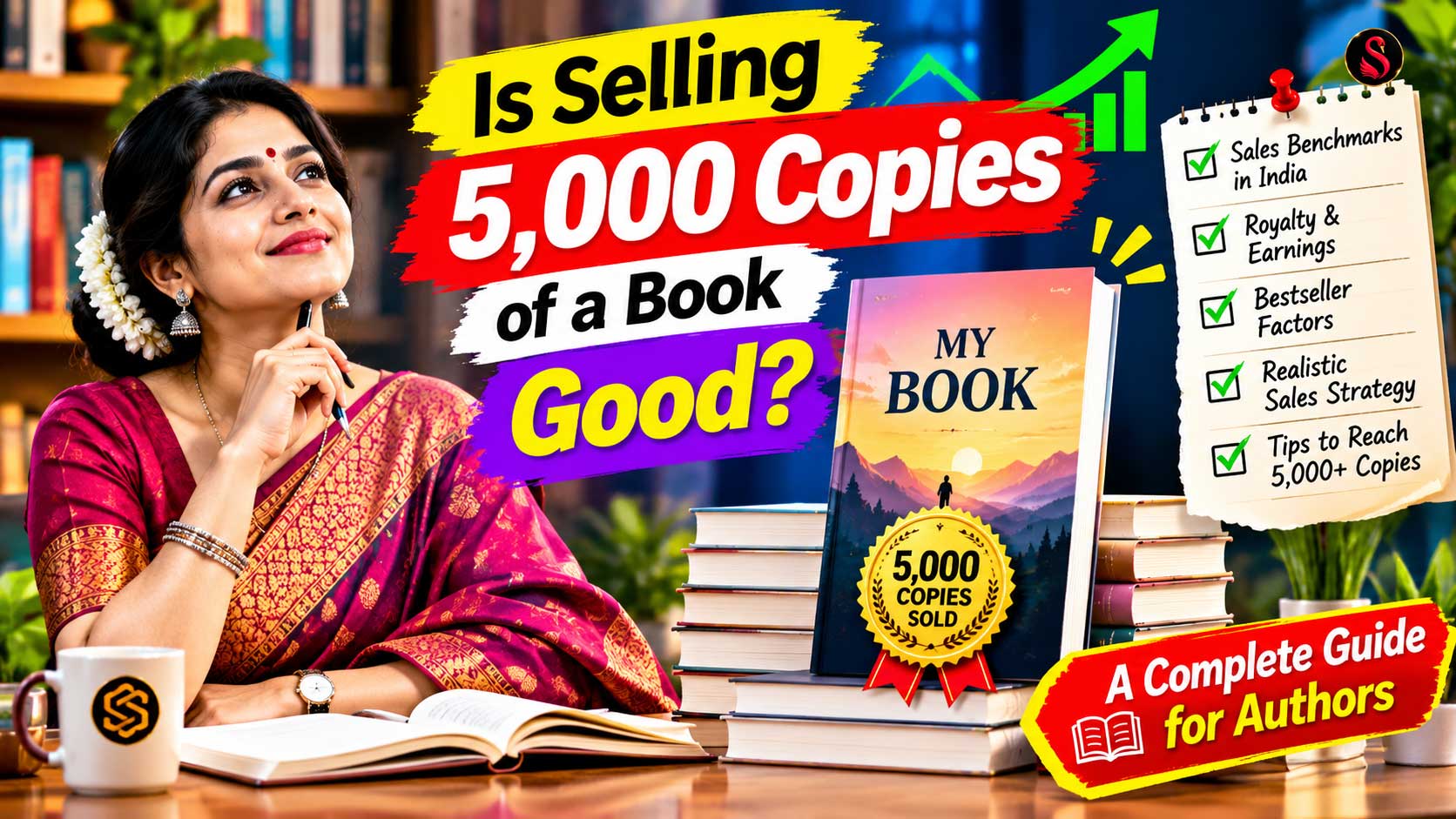
You have written a book, invested your time in editing and publishing it, and finally started receiving sales. Then someone asks you a question:
"How many copies has your book sold?"
Imagine your answer is 5,000 copies.
Is that good? Does it mean your book is successful? Can you call yourself a bestselling author? And more importantly, how much money could you have earned from those sales?
For many first-time authors, selling 5,000 paid copies is a meaningful achievement. However, book sales cannot be evaluated using one number alone. A poetry collection, a literary novel, a competitive-exam guide and a mass-market commercial book have different audiences and sales expectations.
The time taken to sell those copies also matters. Selling 5,000 copies in six months is different from selling the same quantity over five years.
In this guide, we will examine what 5,000 book sales really mean in the Indian publishing market, how author royalties work, how to calculate potential earnings and what you can do to reach that milestone.
Whether you are planning your first book or already have a published title, this article will help you set more meaningful publishing goals.
1. Is Selling 5,000 Copies of a Book Good?
Yes, selling 5,000 genuine paid copies can be a strong achievement, particularly for a first-time author or a specialised literary title.
It indicates that your book has reached a substantial number of paying readers. But the significance of that number depends on several factors:
Genre and subject of the book.
Language and target readership.
Selling price.
Number of months or years taken to sell the copies.
Sales through bookstores, online platforms and direct orders.
Marketing and promotional expenditure.
Author royalty or profit per copy.
Number of copies actually purchased by readers rather than distributed free.
For example, consider two authors.
Author A: Sells 5,000 copies of a Hindi poetry collection over 18 months, mainly through direct reader relationships and literary events.
Author B: Sells 5,000 copies of a commercial nonfiction book over 12 months through a large advertising campaign.
Both have reached the same sales figure, but their business models, expenses and sales performance are different.
Therefore, the right question is not simply whether 5,000 is a good number. It is whether 5,000 copies represent a successful result for your particular book and publishing strategy.
2. How Many Copies Does a Book Need to Sell to Be Successful in India?
There is no official, universal Indian publishing standard that declares a book successful after a fixed number of copies.
Industry professionals use different benchmarks depending on the genre, the publisher's investment, the price and the expected audience.
A useful industry perspective comes from an interview with publisher and literary agent Kanishka Gupta, published by Himalayan Writing Retreat. He discussed the following approximate sales expectations:
These figures are the interviewee's professional perspective, not audited national averages or guaranteed industry thresholds.
Source: In Conversation with Kanishka Gupta – Himalayan Writing Retreat.
What does this mean for a first-time author?
If you are publishing your first book, you should not compare your sales directly with an established celebrity author or a publisher's biggest commercial title.
A debut poet who sells 1,000 paid copies may have achieved something significant. A literary novelist who reaches 5,000 copies may have a strong result. A commercial nonfiction author may need a larger audience to justify the investment.
The correct benchmark should be based on your book's intended readers, realistic demand and financial plan.
3. Is 5,000 Copies Enough to Call Your Book a Bestseller?
Not automatically.
The term "bestseller" is often used in book marketing, but there is no single universal sales number that makes every book a bestseller in every category or marketplace.
Different bestseller lists use different sources and ranking methods. A retailer's bestseller badge, a newspaper's bestseller list and a publisher's internal sales claim may not represent the same measurement.
Indian publishing coverage has also highlighted the difficulty of defining bestseller status because sales datasets and list methodologies differ.
Read: How many copies must a book sell to be a bestseller in India? – Scroll.in.
Understand the difference
5,000 copies sold: A numerical sales milestone.
Bestseller on a particular platform: A ranking achieved under that platform's methodology and category.
National bestseller: A claim that needs credible evidence and a clearly identified ranking or sales basis.
Commercially successful book: A title that meets or exceeds its financial and strategic goals.
If you have sold 5,000 copies, you can accurately communicate that achievement if your records support it. Do not claim a bestseller ranking unless you can substantiate the specific list, category and period.
4. Does Selling 5,000 Copies Mean You Have Earned a Lot of Money?
Not necessarily.
This is where many new authors make a mistake. They multiply the book's printed price by the number of copies sold and assume that the entire amount belongs to the author.
It does not.
The money from a book sale may be shared or reduced by:
Retailer discounts and commissions.
Distributor margins.
Printing and production expenses.
Shipping and fulfilment.
Platform charges.
Taxes.
Publisher's costs.
Contractual royalty arrangements.
The author's actual earnings depend on the agreement.
Example: What is the total retail value of 5,000 books?
Suppose your book has an MRP of ₹300.
This means the 5,000 copies have a combined printed-price value of ₹15 lakh.
It does not mean the author has earned ₹15 lakh.
The author receives only the amount calculated under the relevant royalty or publishing agreement.
5. How Much Royalty Can an Author Earn From Selling 5,000 Copies?
Let's understand this with a practical example.
Assume:
Book MRP: ₹300.
Paid copies sold: 5,000.
Royalty calculation base: ₹300 per copy.
Royalty rates: 7.5%, 10% and 15%.
These rates are used only to demonstrate the mathematics. They are not a promise of what any particular publisher will offer.
Illustrative royalty calculation
For example, at a 10% royalty on ₹300, the author receives ₹30 per qualifying copy.
If 5,000 copies qualify for royalty:
₹30 × 5,000 = ₹1,50,000.
That is the illustrative royalty before any applicable tax or contractual adjustments.
But be careful: Royalty is not always calculated on MRP
Some agreements calculate royalty on the printed price, while others use net receipts or another agreed basis.
For example:
Royalty on MRP: Percentage of the printed book price.
Royalty on net receipts: Percentage of the amount the publisher actually receives after specified deductions.
Flat payment: A one-time agreed amount.
Advance against royalty: An advance that may be adjusted against future royalties.
The Indian government's Publications Division publishes its own author agreement and royalty structure. Its published model includes a 15% royalty on the Indian published price for qualifying sold copies under the stated terms.
Reference: Publications Division – Royalty Structure and Copyright.
Always read your own agreement. Never assume that a percentage quoted by another author applies to your book.
6. What If You Self-Publish and Sell 5,000 Copies?
Self-publishing has a different financial structure from traditional publishing.
In a traditional publishing arrangement, the publisher may finance production and distribution and pay royalties under the contract.
In self-publishing, the author may pay for services such as editing, cover design, formatting, printing and marketing. In return, the author may have greater control over the publishing process and the financial arrangement.
However, more control also means more responsibility.
Example: Illustrative self-publishing calculation
Suppose you self-publish a book with the following assumptions:
Calculation:
₹300 − ₹120 = ₹180 per copy.
₹180 × 5,000 = ₹9,00,000.
This ₹9 lakh is not automatically your final profit.
You still need to account for fixed editing and design expenses, advertising, taxes, unsold stock, returns, discounts, payment charges and any other costs not already included in the ₹120 assumption.
This example illustrates why a self-published author should calculate the economics before choosing a selling price.
7. How Much Time Should It Take to Sell 5,000 Copies?
The time period gives meaning to the sales figure.
Consider the following examples:
These are mathematical averages, not market forecasts.
A book may sell strongly during launch and then slow down. Another may sell slowly at first and build a readership through recommendations, schools, events or long-term online discovery.
For a first-time author, reaching 5,000 paid copies over a longer period can still be a valuable achievement.
Track more than total sales
Keep a monthly sales report showing:
Copies sold.
Copies returned.
Copies discounted.
Free or review copies distributed.
Net paid copies.
Revenue received.
Royalty payable.
Marketing expenses.
Net earnings.
This helps you understand whether your book is growing or whether a short-lived launch campaign created most of the sales.
8. Why Do Some Books Sell 5,000 Copies While Others Struggle?
A good manuscript is important, but book sales depend on more than writing quality.
A. The book solves a clear reader need
Readers need a reason to purchase your book.
For nonfiction, that reason may be learning a skill, understanding a problem or getting practical guidance.
For fiction, it may be an engaging story, memorable characters or a distinctive reading experience.
For poetry, it may be the emotional connection, language, originality and relevance of the collection.
A book with a clearly defined reader is easier to position and promote than one aimed at everyone.
B. The cover communicates the right message
Readers often see a book cover before reading the description.
A cover should communicate the genre and appeal to the intended audience. A poetry book, academic guide and thriller should not all look the same.
A professionally prepared cover can improve presentation, but it cannot compensate for an unsuitable title or weak manuscript.
C. The book description encourages purchase
A useful description should explain:
What the book is about.
Who should read it.
What makes it different.
What the reader can expect.
Why the book is worth considering.
Avoid filling the description with generic claims such as "a life-changing masterpiece" unless you can support them.
D. The book is available where its readers shop
Your readers may discover books through:
Online marketplaces.
Bookstores.
Author websites.
Literary events.
Educational institutions.
Social media.
Book clubs and reading communities.
Direct orders.
Distribution should be planned according to your actual target audience.
A listing on a website does not automatically guarantee availability in every bookstore.
E. The author builds visibility
Readers are more likely to discover a book when its author consistently communicates about it.
Useful activities include:
Publishing excerpts.
Sharing short videos about the book's themes.
Appearing at relevant literary events.
Writing articles related to the subject.
Building an email list.
Requesting honest reviews from actual readers.
Collaborating with relevant communities and reviewers.
F. The book earns genuine recommendations
A recommendation from a reader who genuinely enjoyed a book can help it reach new readers.
Never purchase fake reviews or pressure readers to provide positive feedback. Ask for honest reviews and follow each platform's policies.
9. How to Sell 5,000 Copies of Your Book in India: A Practical Strategy
Reaching 5,000 copies requires a sales plan. Do not depend entirely on one social media post or a single launch event.
Here is a practical approach for an Indian author.
Phase 1: Prepare the book for the market
Before promoting it:
Complete editing and proofreading.
Prepare a professional cover.
Ensure the interior is correctly formatted.
Decide the selling price.
Prepare an accurate book description.
Identify your target audience.
Confirm where the book can actually be purchased.
Prepare a sample or preview.
If the book is not professionally prepared, aggressive promotion may simply bring more readers to a product that is not ready.
Phase 2: Create a launch audience
Start building interest before publication.
For example:
Share the title and cover reveal.
Introduce the author's journey.
Publish selected excerpts.
Share the reason behind writing the book.
Invite interested readers to follow the launch.
Collect genuine expressions of interest.
If you plan to accept pre-orders, explain the price, delivery schedule and refund terms clearly.
Phase 3: Use multiple sales channels
Do not depend on a single marketplace.
Depending on your book and the available distribution arrangements, explore:
Online book marketplaces.
Your own website.
Direct reader orders.
Book fairs.
Literary events.
Schools and colleges for relevant educational titles.
Book clubs.
Relevant community organisations.
Retail bookshops and distributors.
For institutional or bulk orders, use written quotations and clear payment and delivery terms.
Phase 4: Build a 5,000-copy sales target
A target can be broken into smaller milestones.
These are planning milestones, not guaranteed outcomes.
For example, if you aim to sell 5,000 copies in one year, the mathematical average is approximately 417 copies per month. Your actual sales plan should account for launch spikes, seasonal demand and the time needed to build distribution.
Phase 5: Measure and improve
Every month, ask:
Which channel generated the most paid sales?
Which campaign generated enquiries but not purchases?
Which cities or reader groups responded?
What objections did potential buyers raise?
Did discounts improve total contribution or reduce profitability?
Are readers recommending the book?
Are returns or delivery issues affecting sales?
Use these findings to adjust your marketing instead of spending money without measuring results.
10. How Should a First-Time Author Set a Realistic Sales Target?
A first-time author should set targets in stages rather than immediately expecting 5,000 copies.
A practical planning framework could look like this:
Stage 1: First 100 paid copies
Focus on the book's presentation, early readers, direct feedback and the first genuine sales.
Stage 2: First 500 paid copies
Understand which audience responds best and which sales channels are working.
Stage 3: First 1,000 paid copies
Build a repeatable promotion and distribution process.
Stage 4: First 2,500 paid copies
Expand to new reader groups, events, locations and relevant partnerships.
Stage 5: 5,000 paid copies
Strengthen distribution, repeat successful campaigns and improve long-term reader discovery.
This approach gives an author useful feedback at every stage.
You should also distinguish between a sales target and a sales promise. No publisher or marketer should guarantee 5,000 copies merely because a book has been published.
11. What Should Authors Check Before Signing a Publishing Agreement?
If you want to sell 5,000 copies, the publishing agreement matters just as much as the marketing plan.
Before signing, understand:
Copyright ownership
Who owns the copyright? Are you granting the publisher a licence, assigning rights or entering into another arrangement?
Royalty percentage
Is the royalty calculated on MRP, net receipts, or another amount?
Sales reporting
Will you receive a periodic statement showing how many copies were sold, returned, discounted or given away?
Payment schedule
Will royalty be paid quarterly, half-yearly or annually? Is there a minimum payment threshold?
Distribution
Which marketplaces, bookstores and territories are covered? Is distribution confirmed or merely an intention?
Author copies
How many complimentary copies are included? Can you purchase additional copies, and at what price?
Marketing responsibilities
What exactly will the publisher do? Ask for specific deliverables rather than accepting vague promises of "promotion."
Rights reversion
Under what conditions can the publishing rights return to you?
The Publications Division's author agreement is a useful example of the type of clauses authors should examine. It is a government publisher's model agreement, not a universal contract for every publisher.
12. Ready to Publish Your Book? Build Your Publishing Journey With Swarnim Sahitya
If you are aiming to sell 500, 1,000 or even 5,000 copies, the first step is to publish a book that is properly prepared for its readers.
A manuscript needs more than a title and a print file. It needs suitable editing, a reader-friendly layout, a professional cover, correct publication information and a clear plan for reaching its audience.
Swarnim Sahitya Publishing House helps authors explore the publishing process and the services needed to bring their manuscripts closer to publication.
Whether you have written a Hindi poetry collection, a novel, a motivational book, a children's book or a nonfiction manuscript, you can discuss your requirements before choosing a suitable publishing option.
What should you prepare before contacting a publisher?
Your complete manuscript, preferably in an editable file.
Book title and language.
Genre and a short description.
Approximate page count.
Your target readers.
Whether you need editing and proofreading.
Whether you want paperback, hardcover or both.
Your preferred number of printed copies, if any.
Your publishing and distribution expectations.
What should you discuss with Swarnim Sahitya?
Ask about the services relevant to your manuscript, the publishing process, applicable charges, timeline, ISBN arrangements, book specifications, distribution options and royalty terms.
You should understand exactly what is included before making a decision.
Explore your publishing options: https://swarnimsahitya.in/
Your first book does not have to sell 5,000 copies immediately. It needs to be published thoughtfully, presented professionally and introduced to the right readers.
13. Frequently Asked Questions About Selling 5,000 Copies of a Book
Is selling 5,000 copies of a book good in India?
Yes, 5,000 genuine paid copies can be a strong achievement, particularly for a debut author or a specialised literary title. The significance depends on genre, price, time period, distribution, marketing expenditure and the author's financial arrangement.
Is 5,000 copies enough to make a book a bestseller?
Not automatically. Bestseller status depends on the specific ranking list, category, marketplace and period. You should not claim a bestseller title without credible evidence.
How much money can I earn by selling 5,000 books?
It depends on the selling price and royalty agreement. For example, if a ₹300 book pays a 10% royalty calculated on MRP, 5,000 qualifying paid copies would generate an illustrative royalty of ₹1,50,000 before applicable deductions or taxes.
Is selling 1,000 copies of a book good?
For many debut authors, poetry collections and specialised titles, 1,000 paid copies can be a meaningful achievement. The result should be evaluated against the book's genre, investment and sales period.
How many copies should a first-time author aim to sell?
Start with milestones such as 100, 500 and 1,000 paid copies. Once you understand your audience and the channels that generate sales, you can work towards a larger target such as 2,500 or 5,000.
How long does it take to sell 5,000 copies?
There is no fixed timeline. A book with an established audience may reach that target relatively quickly, while a specialised or debut title may take several years. Track monthly paid sales rather than judging performance from the total alone.
Do 5,000 printed copies count as 5,000 books sold?
No. Copies printed, dispatched to distributors, supplied to bookstores and actually purchased by readers are different figures. Use verified sales records and account for returns and free copies.
Can a Hindi poetry book sell 5,000 copies?
Yes, it is possible, but it requires a suitable audience, strong literary quality, discoverability and effective distribution. Poetry sales should not be compared directly with mass-market commercial fiction.
How do I calculate author royalty on 5,000 copies?
First confirm the royalty base in your contract. Multiply the applicable royalty per qualifying copy by the number of qualifying paid copies. Adjust for returns, discounts, advances, taxes and any other contractual provisions.
Can a self-published author earn more than a traditionally published author?
It is possible, but not guaranteed. A self-published author may have greater control over pricing and revenue, but also bears production, marketing and distribution costs. A traditional publisher may finance production but pay royalties under a different arrangement.
Does a publisher guarantee 5,000 sales?
No responsible publishing decision should assume that sales are guaranteed. A publisher may provide defined production or distribution services, but actual sales depend on reader demand, marketing, pricing and many other factors.
How can I get my book published professionally in India?
Prepare your manuscript, decide your target readers, compare publishing models, examine service inclusions and review the contract. You can also discuss your manuscript and publishing requirements with Swarnim Sahitya at https://swarnimsahitya.in/.
Conclusion: 5,000 Copies Can Be a Milestone Worth Celebrating
Selling 5,000 copies is not a small achievement. For many authors, it represents months or years of writing, publishing, promotion and building a relationship with readers.
But do not measure your success only by a number.
Measure how many genuine readers purchased your book, how quickly your audience is growing, how much you earned, whether your publishing investment was recovered and whether your book is continuing to reach new readers.
If you are still at the manuscript stage, do not wait until you have a sales target of 5,000 to begin your publishing journey.
Start with a professionally prepared book. Choose the right publishing arrangement. Understand your royalty terms. Build a realistic audience and keep improving your marketing.
Your journey towards 5,000 readers begins with publishing your first book.
If you are ready to take that first step, explore the publishing options at Swarnim Sahitya Publishing House:
Let's help you move from manuscript to published author—and give your book the professional foundation it deserves.
Comments (0)
Join the conversation with fellow authors.
Login to your Author Account to comment, like comments and reply.