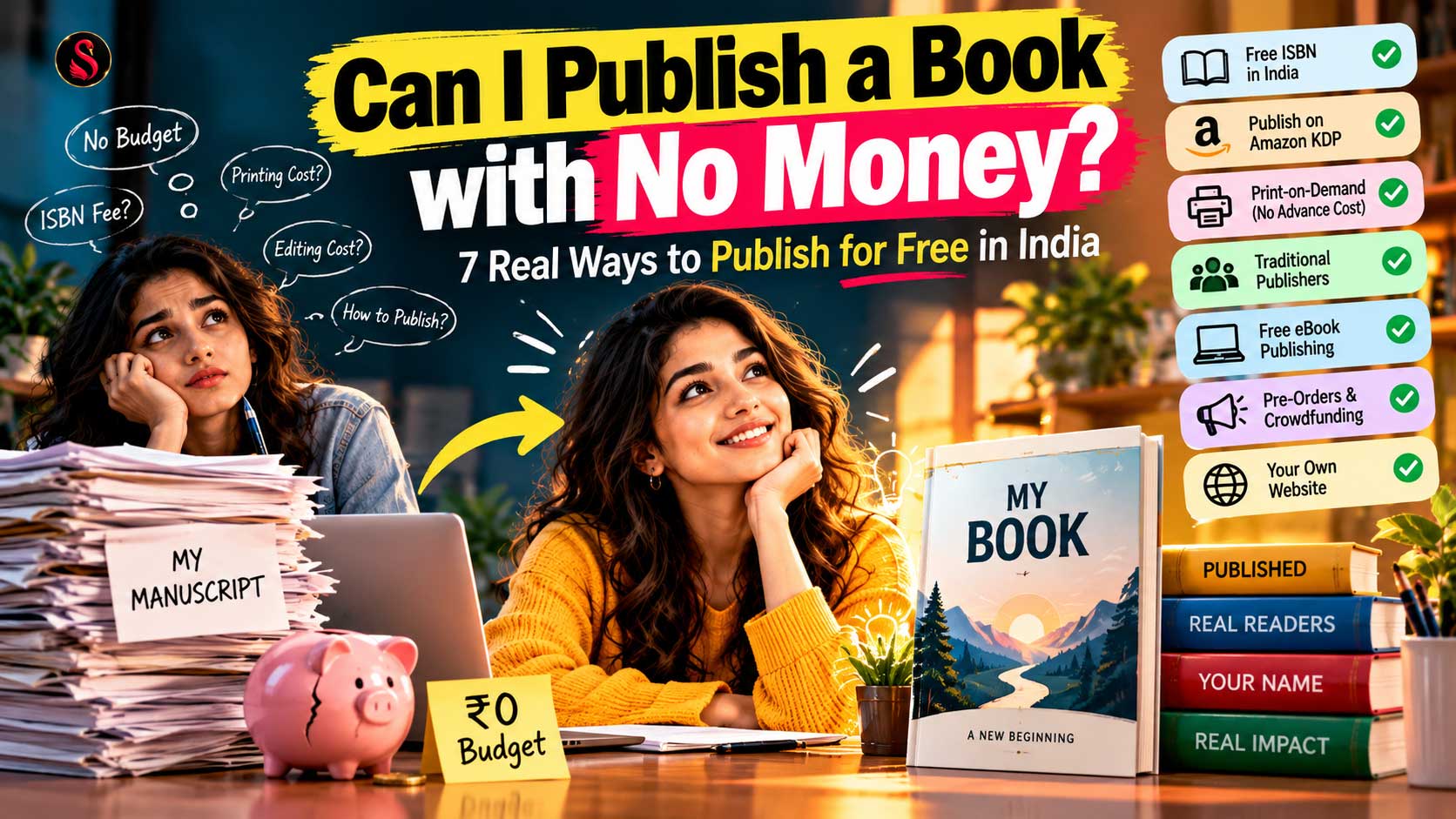
You have written a collection of poems, completed a novel, prepared a motivational book or finally finished the manuscript you have been working on for years. You want to see your name on a published book, but there is one problem: you do not have money to pay for publishing.
Does that mean you must abandon your dream?
No. You can publish a book without spending a large amount upfront, and in some situations, you can bring a book to readers with almost zero out-of-pocket cost. However, you need to choose the right publishing route and understand what is actually free.
For example, a free ISBN does not pay for printing. A free eBook upload does not provide professional editing. A print-on-demand service may avoid advance printing payments, but production costs are deducted when a customer purchases the book.
This guide explains how to publish a book with no money in India, how to obtain a free ISBN, which digital and print-on-demand options to consider, how to approach traditional publishers, and how to avoid publishing offers that look free but become expensive later.
Whether you are a Hindi poet, first-time novelist, student, teacher or nonfiction writer, you will find practical options to move your manuscript towards publication without making unnecessary payments.
1. Can I Publish a Book With No Money in India?
Yes, you can—but the method you choose determines how close you can get to zero cost.
There are several ways to publish without paying a traditional publishing package fee:
Submit your manuscript to a traditional publisher that accepts and finances selected books.
Publish an eBook through a digital platform that does not charge an upfront upload fee.
Use print-on-demand so copies are produced after customers order them.
Apply for an ISBN directly through India's official ISBN agency, where eligible.
Prepare your manuscript, cover and formatting yourself using free tools.
Build an audience and use pre-orders or a carefully planned crowdfunding campaign to finance a print run.
However, these methods are not interchangeable. Some give you more control, some require patience, and some transfer production costs to the publisher or deduct them from sales.
What does "free publishing" actually mean?
The most important distinction is between no upfront publishing fee and no publishing cost at all. A book still needs to be prepared, produced and delivered to readers. Someone has to perform and finance that work.
2. Seven Ways to Publish a Book Without Spending Money
Let's examine the actual routes available to authors, including their advantages, limitations and best use cases.
Method 1: Approach a Traditional Publisher
If you have no money to invest, traditional publishing is one of the first routes worth exploring.
In a traditional publishing arrangement, a publisher selects a manuscript and decides to invest in its publication. Depending on the contract, the publisher may manage:
Editing and proofreading.
Cover design.
Interior layout and typesetting.
Printing and production.
Distribution and retailer relationships.
Marketing and publicity.
The publisher normally recovers its investment through book sales. The author receives an advance, royalty or another agreed form of compensation, depending on the contract.
Do authors pay a traditional publisher?
A genuine traditional publishing offer generally does not require the author to purchase a publishing package or pay for the publisher's ordinary production costs. However, publishing models vary, and some companies operate hybrid or author-funded arrangements.
Do not judge a publisher only by the words "traditional" or "free." Read the agreement.
How to approach a traditional publisher
Identify publishers that publish your genre.
Read their submission guidelines.
Prepare a professional book proposal or submission package.
Send a synopsis and sample chapters where requested.
Include your author biography and target-reader description.
Follow up politely if the publisher provides a response timeline.
For a novel, the publisher may request a synopsis and sample chapters. For nonfiction, a proposal explaining the subject, audience, competing titles and chapter outline may be more useful. Poetry publishers may request a complete collection or a substantial sample.
What should you check in the contract?
Who owns the copyright?
Which language, territory and formats are covered?
How long does the publisher hold the rights?
What royalty percentage or payment formula applies?
Is an advance payable?
Who pays for production?
How are complimentary author copies handled?
What happens if the publisher does not release the book?
When and how do rights return to the author?
Best for: Authors with a complete, strong manuscript who are willing to submit to publishers and accept a selective process.
Limitation: You cannot assume that a publisher will accept your book. You may also have less control over the cover, pricing, publication schedule and marketing decisions.
Method 2: Publish an eBook for Free
An eBook is often the most practical starting point when your budget is zero.
You do not need to print physical copies, purchase paper or pay for courier delivery. You prepare a digital manuscript, create a suitable cover, check the file and upload it to a platform that accepts your book.
Depending on the platform, you may be able to sell the eBook or make it available for free.
What do you need?
A final manuscript in a supported format.
A properly designed digital cover.
A clear title and author name.
A book description.
Relevant categories and search terms.
Rights to all text and images.
A payment and tax setup if you intend to receive royalties.
Platforms to investigate
Amazon Kindle Direct Publishing (KDP)
<Link url="https://kdp.amazon.com/" title="Amazon Kindle Direct Publishing"/>
KDP allows authors to publish eligible Kindle eBooks without paying an upfront publishing fee. You upload your book, provide its metadata, select territories and pricing, and submit it for review.
KDP offers different eBook royalty options, subject to eligibility and territory-specific conditions. Review the official eBook pricing and royalty guidance.
Google Play Books
<Link url="https://play.google.com/books/publish/" title="Google Play Books Partner Center"/>
Google Play Books provides a partner publishing system for eligible publishers to submit eBooks, manage book details and make titles available for sale in supported countries.
Check the Google Play Books Partner Center for supported countries, content rules, file requirements and payment arrangements.
Important: A platform accepting eBooks does not automatically mean it supports every Indian language, format, territory or type of book. Check the current rules for your specific title before investing time in conversion and upload.
Is eBook publishing really free?
The upload process may have no upfront charge, but optional services such as professional editing, illustration, cover design, advertising and conversion can cost money. If you do the work yourself using suitable free tools, you can keep your initial spending very low.
Best for: Poetry collections, short books, novels, study guides and nonfiction books that readers are comfortable reading digitally.
Method 3: Use Print-on-Demand Instead of Buying Printed Copies in Advance
Many first-time authors believe they must order 100, 200 or 500 copies before they can publish a paperback.
That is not always true.
Print-on-demand (POD) is a model in which a physical copy is printed when a customer places an order. You do not need to buy a large quantity of stock before the first sale.
Amazon KDP offers print-on-demand for eligible paperback and hardcover books. According to its official publishing information, authors can publish without paying an upfront printing bill. The printing cost is deducted when a sale is made, before the applicable royalty is calculated.
How does print-on-demand work?
Prepare your print-ready interior PDF and cover file.
Create your book listing on the platform.
Select an eligible trim size, paper and printing option.
Set a price within the platform's allowed range.
Submit the book for review.
When a reader orders it, the platform prints and fulfils the order.
The applicable printing cost and other deductions are accounted for in the royalty calculation.
Example: Understand the economics
Suppose a book is listed at ₹299.
The amount you receive is not automatically ₹299. For a print-on-demand paperback, the calculation depends on the marketplace, printing cost, applicable royalty rate, taxes and other platform rules.
A simplified illustration:
This is only an example to explain the calculation. It is not a quoted KDP royalty or a guaranteed payout. Always use the platform's live calculator and actual book specifications.
Is print-on-demand available for every Indian author and language?
Do not assume so.
Print-on-demand availability depends on the platform, marketplace, format, language and technical eligibility. Amazon's language and format rules have specific limitations for certain Indian-language print editions. For example, its Indian-language publishing guidance should be checked before planning a Hindi paperback around KDP.
If your goal is to sell a Hindi paperback to readers in India, confirm that the exact language, format and intended sales marketplace are supported. If not, compare other distribution or local printing arrangements.
Best for: Authors who want to offer physical books without purchasing a large print run in advance.
Limitation: You may have less control over print specifications, local availability, retail pricing and fulfilment. Printing costs still exist; they are deducted from sales rather than paid upfront.
Method 4: Apply for a Free ISBN in India
An ISBN (International Standard Book Number) is a unique identifier used for a particular book publication and format. It helps identify books in the publishing and book-trade system.
The good news for Indian authors is that ISBNs are allotted free of cost by India's national ISBN agency, subject to the application process and eligibility.
You do not have to pay a private company simply to obtain an ISBN if you are eligible to apply directly.
Where can you apply?
Use the official government portal:
The agency operates under the Ministry of Education and is known as the Raja Rammohun Roy National Agency for ISBN.
Can an individual author apply?
Yes. The official application guidance includes applicant categories such as:
Author.
Self Publisher/Individual Publisher.
Individual Publisher.
Institutional Publisher.
Commercial Publisher.
Select the category that correctly describes your publishing arrangement. Do not register under an incorrect category simply to obtain an ISBN.
How to apply for an ISBN
Visit the official ISBN portal.
Register using the appropriate applicant category.
Complete your applicant details.
Provide the required supporting documents.
Submit the book information and application.
Monitor your application status.
Use the ISBN only for the publication and edition to which it has been assigned.
The required documents and process can depend on your applicant category. Read the official ISBN application instructions before submitting.
Does an ISBN cost money in India?
The government ISBN allotment is free. If an agency, designer or publisher charges you for handling the application, ask whether the amount is for its service rather than the ISBN itself.
Does an ISBN give me copyright?
No.
An ISBN identifies a publication; it does not establish that you own copyright, prove that the manuscript is original or replace any legal rights documentation.
Does every version need a separate ISBN?
Different editions and formats may require separate ISBNs—for example, paperback, hardcover and eBook editions. A revised edition may also require a new ISBN under the applicable ISBN rules. Check the official agency guidance for your exact publication.
Best for: Eligible Indian authors who want to self-publish and manage their own publication identity.
Method 5: Publish Your Book on Your Own Website
If you already have a website, you can use it to build an audience and make your book available digitally.
For example, you can create a page containing:
Book title and cover.
Author introduction.
Book description.
Sample pages or a preview.
A downloadable eBook, if you choose to distribute it.
A payment option, if you are selling it.
Contact details and customer support information.
You can also publish selected chapters, poems or short stories as free content to attract readers.
How can you do this with no budget?
Start with what you already have:
Create a free or existing website page.
Prepare a clean PDF or supported eBook file.
Add a meaningful book description.
Publish sample content.
Share the page through your social media accounts and author communities.
Collect genuine reader feedback.
Introduce a paid edition when you are ready.
If you already own a website, you may avoid purchasing a separate domain or hosting plan. If you do not, a free website option may have limitations, branding or storage restrictions.
Important: Selling directly is not the same as distribution
When you sell directly, you are responsible for payment collection, file delivery, customer communication, refunds where applicable, tax compliance and protecting customer information.
A free website does not automatically provide a complete e-commerce system.
Best for: Authors who have an existing website, blog or online community and want to build a direct relationship with readers.
Method 6: Use Pre-Orders or Crowdfunding to Finance Printing
Suppose you want a paperback, but the printer asks you to pay for 100 or 200 copies before production.
You do not have the money.
One possible route is to build reader interest before printing.
You can announce the upcoming book, share a genuine sample, explain the project and invite readers to pre-order it. If enough readers commit and pay, you may be able to use those funds to finance the print run.
Crowdfunding is another option, where supporters contribute towards a clearly explained publishing project in exchange for agreed rewards or other benefits.
A practical pre-order process
Step 1: Finish the manuscript. Do not take payments for a book that is only an idea.
Step 2: Prepare a sample. Share a few approved pages, a sample chapter or a small selection of poems.
Step 3: Calculate the real cost. Get a written quotation for printing, packaging, delivery, payment processing, taxes and other expenses.
Step 4: Set a realistic target. Work out how many orders you need to cover the planned production cost.
Step 5: Communicate the timeline. Explain when the book is expected to be printed and dispatched.
Step 6: Keep buyers informed. Provide updates if there are delays or changes.
Step 7: Deliver what you promised. Maintain records of payments, addresses, fulfilment and refunds.
Example: A simple funding calculation
Assume your estimated project cost is ₹15,000 and you expect to sell each pre-order for ₹300.
You would need 50 orders to collect ₹15,000 in gross revenue.
However, that is not the same as making a profit. Payment charges, taxes, packaging, courier, damaged copies and other expenses can increase the amount required.
Do not spend pre-order money on unrelated activities. Clearly communicate your terms and comply with applicable consumer and payment rules.
Best for: Authors with an engaged audience who want physical copies but cannot finance a print run themselves.
Limitation: There is no guarantee that readers will pre-order. You must be able to fulfil orders or refund customers if the project cannot proceed.
Method 7: Collaborate With Literary Organisations, Institutions or Writing Communities
Another possibility is to find an organisation that supports literature, education or regional-language publishing.
Depending on the organisation and its current programmes, opportunities may include:
Literary competitions with publication awards.
Institutional publishing projects.
University or research publication support.
Sponsored anthologies.
Community-supported books.
Grants or fellowships for eligible literary projects.
These opportunities are not universally available, and many are highly selective. Always check eligibility, application deadlines, rights terms and the actual benefits offered.
For example, writers may investigate programmes and publications associated with Sahitya Akademi, but should not assume that it offers an open, automatic free-publishing service for every manuscript.
Best for: Literary authors, researchers, educators and writers whose projects fit a particular institution's mission.
3. Which Is the Best Free Publishing Method for Your Type of Book?
The best route depends on what you have written and what you want to achieve.
My recommendation for first-time Indian authors
If you have no budget at all, consider this sequence:
Complete your manuscript.
Edit and proofread it yourself, then ask trusted readers to review it.
Prepare a clean digital edition.
Investigate traditional publishers that accept your genre.
Apply for an ISBN if your chosen route requires one and you are eligible.
Start with an eBook or an eligible print-on-demand route.
Build an audience before investing in physical copies.
This approach allows you to test the book's appeal without immediately committing to a large print order.
4. What Publishing Expenses Can You Actually Avoid?
You do not need to pay for every service from the beginning. Some tasks can be completed independently, particularly if you have the time and the necessary skills.
Manuscript writing
You can write your own manuscript without hiring a writer. However, writing independently does not mean skipping revision.
Editing and proofreading
You can conduct an initial self-edit and ask a few reliable readers to identify unclear passages, spelling errors and structural weaknesses.
For a serious commercial book, a professional editor may still be a worthwhile investment. A poor-quality manuscript can damage reader trust and reviews.
Cover design
You can create a basic cover using free design tools such as Canva. Check the tool's current licensing and commercial-use terms, especially for stock elements, fonts and templates.
Do not use random images from Google Search. An image being publicly visible does not mean you have permission to put it on a commercial book cover.
Interior formatting
For simple manuscripts, you can use word-processing software and suitable templates. More complex books, especially poetry, children's books and image-heavy titles, may need specialist typesetting.
ISBN
Eligible authors can apply through the official government ISBN portal without paying an ISBN allotment fee.
Printing
Print-on-demand can avoid the need to buy stock in advance. For a conventional print run, you will normally need to arrange payment before the printer produces the copies.
Marketing
You can begin with organic promotion:
Share excerpts from your book.
Publish useful articles related to its subject.
Create short videos explaining your ideas.
Participate in relevant reader and author communities.
Ask early readers for honest feedback.
Build an author profile and mailing list.
Approach suitable book reviewers and literary communities.
Free marketing still takes time, planning and consistent work.
5. How to Publish a Book for Free: A 30-Day Action Plan
If your manuscript is already complete, this plan can help you move towards publication without making unnecessary purchases.
This is a planning schedule, not a promise that a government ISBN, publisher acceptance or platform approval will be completed within 30 days. Actual processing times vary.
6. How to Avoid Fake Free Book Publishing Offers
Some authors are so eager to publish their first book that they agree to a service without checking what it includes.
Be careful when a company advertises:
"100% free publishing" but later asks you to buy a fixed number of copies.
"Free ISBN" but does not clarify whose name the ISBN is registered under.
"Guaranteed bestseller" without credible evidence.
"Guaranteed Amazon ranking" or guaranteed sales.
"Free publishing" but requires expensive mandatory marketing packages.
"Lifetime distribution" without defining retailers, territories and duration.
"100% royalty" without explaining printing, distribution or other deductions.
Ask these questions before agreeing
Is there any upfront payment?
Is purchasing printed copies compulsory?
Who is responsible for editing and proofreading?
Who designs the cover and formats the interior?
Who applies for the ISBN, and who is recorded as the publisher?
Who owns the copyright?
What royalty will I receive, and how is it calculated?
Which online and offline stores will actually list my book?
Are there any recurring, renewal or distribution charges?
What happens if I want to withdraw my book or change publishers?
Get the answers in writing. Do not rely on verbal promises.
A special warning about ISBN ownership
The ISBN agency's guidance explains that an ISBN supplied from a self-publishing platform's own registrant element identifies that platform as the publisher for the relevant ISBN record. If you later move to another platform, you may need a new ISBN.
Read the official ISBN manual before deciding whether to use a platform-provided ISBN or apply under your own publishing identity.
7. Should You Choose Free Publishing or Paid Publishing?
Free publishing is not automatically better, and paid publishing is not automatically better.
The right decision depends on the work your manuscript needs and what you want to achieve.
When should you spend money?
Consider paying for a service only when:
The manuscript needs editing beyond your ability.
The cover needs professional genre-specific design.
The interior requires specialist typesetting.
You need printed copies for a specific event or audience.
A service provides genuine distribution or support you cannot manage yourself.
The quotation and contract clearly explain what you receive.
Do not pay for a package simply because someone tells you that a book cannot be published without it. First identify which work you actually need.
8. How Swarnim Sahitya Can Help Authors With Limited Budgets
Not every author needs the same publishing package.
A poet with a completed manuscript may need proofreading, cover design and formatting. A first-time novelist may need structural editing, professional typesetting and help understanding distribution. An author who already has an eBook may need support preparing a paperback edition.
At Swarnim Sahitya Publishing House, authors can explore publishing support based on their manuscript and requirements.
If you have limited funds, the sensible first step is to discuss your book before purchasing a package. Explain:
Your manuscript's language and genre.
Approximate page count.
Whether the manuscript is complete.
Whether you need editing or only formatting.
Whether you want an eBook, paperback or both.
Whether you need printed copies.
Your available budget.
You can then understand which services are relevant and which work you may be able to handle yourself.
Explore Swarnim Sahitya: https://swarnimsahitya.in/
A good publishing decision should be based on transparent services, clear costs and suitable terms—not pressure to purchase unnecessary extras.
9. Frequently Asked Questions About Publishing a Book With No Money
Can I publish a book for free in India?
Yes. You can use eligible digital publishing platforms, apply for a free ISBN through India's official ISBN agency where applicable, submit your manuscript to traditional publishers or use print-on-demand to avoid paying for stock in advance. Optional services and production costs may still apply.
Can I publish a book without paying a publisher?
Yes. You can self-publish using digital platforms or submit your manuscript to a traditional publisher that finances selected books. The two routes have different rights, responsibilities and payment arrangements.
Is ISBN free for authors in India?
Yes. India's national ISBN agency allots ISBNs free of charge through its official application process. Visit isbn.gov.in and choose the correct applicant category.
Can I publish my book on Amazon for free?
Amazon KDP does not charge an upfront fee to publish eligible eBooks, paperbacks and hardcovers. For print-on-demand books, printing costs are deducted from the royalty calculation when a sale is made. Check current marketplace and language eligibility before submitting.
Can I publish a paperback without paying printing costs upfront?
Print-on-demand may allow you to offer eligible paperback titles without purchasing a print run in advance. The printing cost is deducted when an order is fulfilled. Availability depends on the platform, language, format and marketplace.
Can I publish a Hindi book for free?
You may be able to publish a Hindi eBook or use another suitable publishing route without paying an upfront publishing fee. However, check language and format eligibility carefully, particularly for paperback distribution.
Can I publish my poetry book without money?
Yes. You can submit your poetry collection to publishers that accept poetry, prepare a digital edition or investigate suitable print-on-demand options. Before publishing, check poem arrangement, spelling, punctuation, originality and the rights to any quoted material.
Do I need to buy 100 copies before publishing?
No. A large advance print order is not compulsory for every publishing route. Digital publishing and print-on-demand can avoid the need to buy a bulk quantity in advance.
Can I get a free book cover design?
You can create your own cover using suitable free design tools, subject to their commercial-use terms. If you use stock images, fonts or templates, confirm that the licence allows commercial book-cover use.
Can I sell my book after publishing it for free?
Yes, if the platform and your rights arrangement permit commercial sales. A free upload does not mean the book must be given away. You can set a price under the platform's rules and receive applicable royalties or payments.
Does free publishing mean I keep 100% royalty?
No. Your earnings depend on the platform, retailer, printing cost, distribution arrangement, contract and other deductions. Always check the actual royalty formula rather than relying on a headline percentage.
Can a publisher ask me to buy my own books?
A publisher or service provider may offer author copies for purchase, but you should understand whether buying them is optional or compulsory. If the offer is described as traditional publishing, examine why the author is being asked to finance production.
Is free publishing suitable for a first-time author?
It can be an excellent way to begin, especially if you are comfortable preparing your own manuscript and starting with digital distribution. However, do not sacrifice readability, factual accuracy or legal clarity just to avoid every possible expense.
10. Final Checklist: Can You Publish Your Book With Zero Budget?
Before you begin, check whether you have completed these tasks:
My manuscript is complete.
I have checked spelling, grammar and chapter structure.
I have obtained feedback from at least a few reliable readers.
I have selected the right publishing route.
I have checked the platform's current language and format requirements.
I have prepared a basic cover and interior file.
I have checked whether an ISBN is needed for my chosen route.
I understand the copyright and publisher-of-record arrangements.
I have checked all fees and deductions.
I understand how royalties or sales payments are calculated.
I have a plan to reach potential readers.
I have not agreed to compulsory purchases or unclear charges without reviewing the contract.
Conclusion: You Do Not Need a Big Budget to Begin Your Publishing Journey
Not having money should not automatically stop you from publishing your book.
You can begin with a digital edition, approach traditional publishers, apply for a free ISBN in India where eligible, use print-on-demand or build an audience before financing a print run.
But remember: free publishing does not mean that quality, rights and professional preparation do not matter. A book deserves careful editing, a suitable cover, correct formatting and a publishing route that matches the author's goals.
Start with the manuscript you already have. Identify what you can do yourself, what you need help with and which costs can genuinely be avoided.
If you are ready to take the next step, visit Swarnim Sahitya Publishing House and explore the publishing support available for your book.
Your budget may be limited. Your opportunity to become a published author does not have to be.
Comments (0)
Join the conversation with fellow authors.
Login to your Author Account to comment, like comments and reply.