
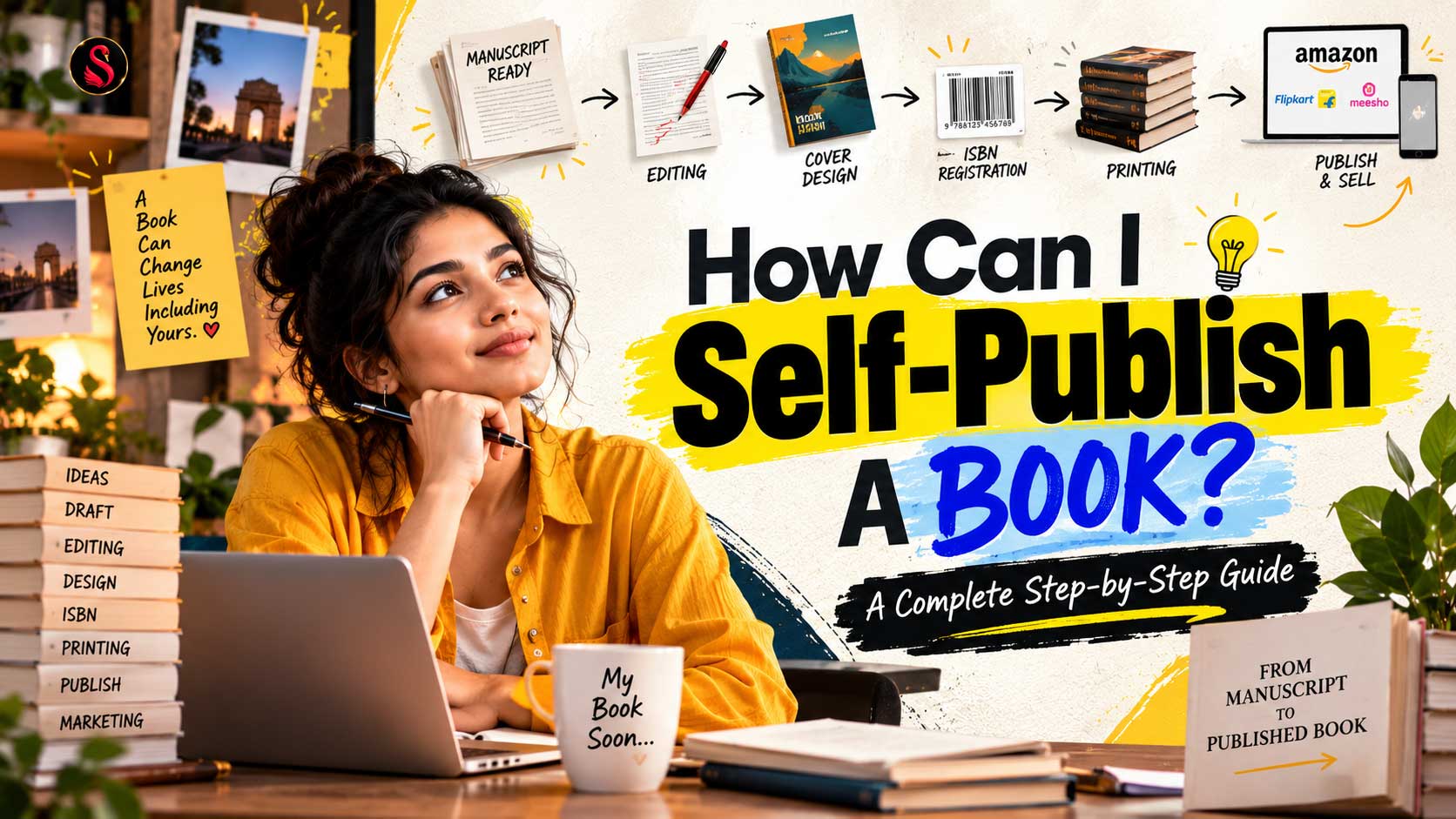
Have you written a novel, poetry collection, motivational book, autobiography, academic work or nonfiction manuscript and want to publish it under your own control?
Self-publishing gives authors a way to turn a finished manuscript into a professionally produced book without depending entirely on a traditional publisher to accept it. You can decide how your book looks, which formats to release, where to sell it, how to price it and how to promote it.
However, publishing a book involves more than printing copies or uploading a Word document to a website. You need to prepare the manuscript, arrange editing and cover design, understand ISBN requirements, select a publishing route, calculate the cost of production, plan distribution and develop a realistic marketing strategy.
This guide explains how to self-publish a book in India, whether you are a first-time author, a Hindi poet, a novelist, a nonfiction writer or someone preparing to publish independently for the first time.
By the end, you will understand the publishing process, the decisions you must make before spending money, the official resources you can use and the mistakes that can cost authors time, money and control over their work.
Quick Answer: How Do You Self-Publish a Book in India?
The basic process is:
Complete and revise your manuscript.
Choose your publishing route: independent self-publishing, a publishing platform or a paid publishing-services provider.
Get professional editing and proofreading appropriate to your book.
Finalise the title, subtitle, book size, cover design and interior layout.
Decide who will be the publisher of record and obtain the appropriate ISBN if required.
Prepare print-ready files and an eBook file.
Choose printing, online retailers and distribution channels.
Set your book's price after calculating production and selling costs.
Review a physical proof or digital preview before release.
Publish, promote the book and monitor sales, reader feedback and expenses.
You can start with an eBook, publish a paperback, produce a hardcover or release several formats. The right combination depends on your audience, budget, book genre and publishing goals.
For an official overview of Amazon's publishing process, visit Kindle Direct Publishing (KDP). For ISBN information in India, use the Raja Rammohun Roy National Agency for ISBN.
1. Decide What Self-Publishing Means for Your Book
Before comparing services or paying for a publishing package, understand the different routes available to Indian authors.
Option A: Publish independently
You act as the publisher and manage the process yourself. You may hire separate professionals for editing, cover design, typesetting, printing and marketing.
Best for: Authors who want greater control over their publishing decisions and are comfortable managing multiple suppliers.
Advantages
You control the book's content, design, price and release plan.
You can choose which professionals to hire.
You can select your preferred publishing imprint and ISBN arrangement.
You can test an eBook or a small print run before investing in larger quantities.
Challenges
You must coordinate the production process.
Quality control and distribution are your responsibility.
You need to understand retailer fees, printing costs and marketing.
Option B: Use an online self-publishing platform
Platforms such as Amazon KDP allow authors to upload book files and publish eligible eBooks and print formats through the platform.
This can be convenient when you want to reach readers through a particular retailer without managing every printing and sales transaction yourself.
However, a listing on one retailer does not automatically mean your book is available in every bookstore, on every marketplace or in every physical shop.
Best for: Authors who want to sell digitally or use a platform's supported print-on-demand service.
Option C: Hire a publishing-services provider
A publishing-services company can help with tasks such as editing, book cover design, formatting, ISBN coordination, printing and distribution setup. Depending on the agreement, the author may pay a service fee while retaining the copyright.
Best for: First-time authors who want professional assistance but do not want to manage every production task personally.
Before choosing a provider, check the written agreement, service inclusions, rights ownership, distribution scope, royalty calculation, delivery timeline and refund policy.
A paid publishing service is not automatically a traditional publishing deal. If you pay for production, understand exactly what you are buying and what the provider is contractually responsible for delivering.
Which publishing route should you choose?
Do not select a route simply because it promises the largest number of sales channels. Choose the route that actually reaches your intended readers.
2. Prepare Your Manuscript Before Approaching Anyone
A complete manuscript is the foundation of the publishing process. If you begin design or printing before the content is ready, later corrections can create additional work and expense.
Step 1: Finish the manuscript
Make sure the book has a clear beginning, a coherent structure and a complete ending. For poetry collections, arrange poems thoughtfully and remove accidental duplicates. For nonfiction, check the order of chapters, examples, references and exercises. For fiction, review plot continuity, character development, pacing and dialogue.
Prepare a clean working file in Microsoft Word or another suitable word processor. Keep a separate backup of the original manuscript.
Step 2: Check originality and permissions
Before publication, verify that:
The text is your original work or you have the necessary rights to use it.
Quotations, photographs, illustrations, lyrics, charts and other third-party materials have the required permissions where applicable.
Names, factual claims and references are checked where relevant.
Any co-authors, translators, illustrators or contributors have clear written agreements about their contributions and rights.
An idea and its written expression are not the same thing under copyright law. Copyright protects qualifying original expression, not an abstract idea by itself.
For official information, read IP India's Copyright Basics.
Step 3: Get an independent editorial review
Self-publishing does not mean you must edit everything yourself.
Depending on the manuscript, you may need one or more of the following:
Developmental editing: Reviews structure, argument, plot, chapter order and overall readability.
Line editing: Improves sentence construction, flow, tone and clarity.
Copyediting: Checks grammar, spelling, consistency and usage.
Proofreading: Identifies remaining errors after the manuscript has been edited and formatted.
Not every book requires every service. A short poetry collection may need a different editorial approach from a 70,000-word novel or a technical nonfiction book.
Ask an editor what the service includes, whether revisions are included, how many words the quote covers and whether the final file will be returned with tracked changes.
Practical tip: Do not approve a cover or final interior layout while major chapters are still changing. Final pagination depends on the actual text and formatting.
3. Choose Your Book's Title, Subtitle and Target Reader
A book title should be memorable, relevant to the content and suitable for the audience you want to reach.
Before finalising it, ask:
Who is most likely to read this book?
What will readers understand from the title?
Does the subtitle explain the subject or benefit?
Is the title already being used by another prominent book?
Can readers spell and remember it easily?
For example, a motivational nonfiction book might use a clear subtitle that communicates the subject, while a poetry collection may benefit from a distinctive literary title and a short description of its emotional theme.
Research comparable books in your genre. Look at their titles, subtitles, categories, descriptions and reader reviews. Use this research to position your book, not to copy another author's branding or content.
Also prepare a concise book description. It should explain what the book is about, who it is for and why someone might want to read it. Avoid unsupported claims such as “India's number-one book” or guaranteed bestseller language.
4. Select the Right Book Format and Size
Before commissioning typesetting, decide which formats you intend to publish.
Common formats
Paperback: Often suitable for novels, poetry, memoirs, general nonfiction and many first-time publications.
Hardcover: Can work well for gift books, premium editions, illustrated books and selected nonfiction titles. It usually has different production costs from a paperback.
eBook: Allows readers to purchase and read a digital edition on compatible devices and apps. It avoids physical printing and shipping for the digital product, although production, platform and marketing costs may still apply.
Audiobook: An additional format for books suited to listening. It requires narration, audio production and distribution arrangements.
How do you choose a book size?
Commonly used sizes include 5 × 8 inches and 5.5 × 8.5 inches, although the best choice depends on the genre, page count, typography, printing method and platform requirements.
Consider:
Reader comfort and portability
The amount of text on each page
Paper quality and opacity
Binding and cover requirements
Printing cost and minimum order quantity
Whether your selected printer supports the dimensions
For poetry, line breaks and whitespace may be central to the reading experience. For academic or illustrated books, diagrams, tables and image placement may affect the ideal dimensions.
Do not finalise a cover template until you know the trim size, final page count, paper specifications and binding method. These details determine the spine width and other cover measurements.
5. Understand ISBN Requirements in India
An ISBN, or International Standard Book Number, is a unique identifier used to identify a particular book edition and format in publishing and book-trade systems.
In India, ISBNs are administered by the Raja Rammohun Roy National Agency for ISBN, under the Department of Higher Education, Ministry of Education.
The agency's official information states that Indian authors who self-publish can apply through the national system.
How to apply for an ISBN
Visit isbn.gov.in.
Review the application instructions for your applicant category.
Register or sign in using the official process.
Complete the required applicant and book information.
Upload the documents requested by the portal.
Submit the application and monitor its status.
Use the allotted ISBN only in accordance with the agency's requirements and the details of the edition.
The exact documents and approval timeline depend on the current process and applicant category. Follow the instructions displayed by the official portal rather than relying on an unofficial website's checklist.
Does every book need an ISBN?
The answer depends on the format and where you intend to publish.
For books intended for standard trade distribution, an ISBN is often important. An ISBN helps identify an edition, but it does not itself guarantee a listing, bookstore placement, sales or copyright protection.
Some platforms allow eligible eBooks to be published without an ISBN. For example, Amazon KDP says ISBNs are optional for eBooks, while its paperback and hardcover workflows have different requirements. Review KDP's ISBN and imprint guidance before deciding.
Does a paperback and hardcover use the same ISBN?
Different formats and editions generally require separate ISBNs when they are separately identified products. A paperback, hardcover and eBook should not automatically be treated as one ISBN-bearing edition.
If you publish with your own ISBN, check that the title, author, publisher or imprint and format details match the official registration.
Important: An ISBN identifies a book product; it is not a substitute for a publishing contract, rights agreement or copyright registration.
6. Understand Copyright and Protect Your Rights
One of the most important questions for a first-time author is: “Will I still own my book after publishing?”
The answer depends on the rights you own and the agreement you sign.
In India, copyright in an original qualifying literary work generally arises automatically when the work is created; registration is not a prerequisite to the existence of copyright. Registration can nevertheless provide useful evidence in a dispute.
Read the official IP India Copyright Basics and the Copyright Office filing process if you are considering registration.
Before signing a publishing agreement, check:
Who owns the copyright?
Is the agreement exclusive or non-exclusive?
Which formats and territories are covered?
How long do the rights remain with the other party?
Can you publish a revised edition elsewhere?
What royalty or revenue share will you receive?
How often will sales statements and payments be provided?
What happens if the book goes out of print or the service ends?
Can you terminate the agreement, and under what conditions?
Who controls the ISBN and publishing imprint?
If a provider says you will retain copyright, ask for that provision in the written agreement. Do not rely solely on a verbal assurance or a promotional message.
7. Get a Professional Book Cover Designed
Your cover is part of the reader's first impression. It must work both as a physical object and as a small thumbnail on a phone screen.
A strong cover communicates the genre, tone and intended audience. It should be visually distinct from competing titles and remain legible when reduced in size.
What a complete cover package may include
Front cover
Back cover
Spine design
Barcode area where required
Print-ready cover file
Digital eBook cover file
Source files or editable assets, if included in the agreement
The precise deliverables depend on the format and service provider.
What should you tell your cover designer?
Provide the title, subtitle, author name, genre, target readership, short synopsis, comparable titles and visual references. Explain which elements you like about those references without asking the designer to copy another cover.
For a Hindi poetry book, typography and emotional tone may be particularly important. A business book may require a different visual hierarchy from a literary novel or a children's picture book.
Check the cover before approval
Is the title spelled correctly?
Is the author's name accurate?
Is the subtitle readable?
Does the design suit the genre?
Is the text legible at thumbnail size?
Does the back cover contain the approved description and author bio?
Does the print file follow the selected printer's specifications?
Do not approve a generic cover merely because it looks attractive. The cover should represent your particular book.
8. Format the Interior of the Book
Interior formatting, also called typesetting or book layout, converts the edited manuscript into a reader-friendly print or digital edition.
For print books, the file needs to meet the selected printer's requirements. For eBooks, the layout should work across supported reading devices and screen sizes.
Print formatting checklist
Correct trim size and page dimensions
Appropriate margins and binding allowance
Consistent chapter headings
Readable font and line spacing
Correct page numbering
Consistent paragraph spacing and indentation
Proper placement of illustrations and tables
Front matter and back matter
Correct treatment of blank pages where needed
Embedded or otherwise correctly prepared fonts, as required
Print-ready PDF that meets the printer's specifications
eBook formatting checklist
A clean digital manuscript
Functional table of contents where supported
Consistent headings and chapter navigation
Properly handled images
Correct language and text encoding
Readable layout on different screens
An appropriate supported file format, such as EPUB where accepted
Special considerations for Hindi books
Hindi manuscripts require careful Devanagari font selection, matra placement, conjunct rendering, punctuation, paragraph flow and proofing. Text should be checked in the final exported file, not only in the original Word document.
If your book contains poetry, check every line break and stanza. If it contains Sanskrit verses, transliteration, footnotes or bilingual content, verify the alignment and rendering in both the print proof and digital preview.
Amazon KDP currently supports Kindle eBooks in several Indian languages, including Hindi. Its documentation also states that paperback publishing for Indian-language content is not currently available through KDP. Hindi paperback authors should therefore verify their physical-printing and distribution route separately. See KDP's Indian-language publishing guidance.
9. Calculate the Cost of Self-Publishing in India
There is no single fixed price for self-publishing a book. The total depends on manuscript length, editing needs, book format, design complexity, paper, binding, print quantity, distribution and marketing.
The most useful approach is to prepare a budget based on actual quotations rather than choosing a package solely because it is advertised as cheap.
Costs you may need to consider
Some tasks can be handled by the author, while others may be worth outsourcing. Do not compromise on essential quality checks simply to minimise the initial bill.
How to compare publishing packages
Ask each provider to give you an itemised quotation.
For example, if one package includes editing, cover design, interior formatting, ISBN assistance, 20 printed copies and online listing, while another includes only formatting and listing, the headline prices are not directly comparable.
Ask these questions:
Is professional editing included, or only basic proofreading?
Does the cover price include paperback and hardcover files?
How many printed copies are included?
Is shipping included?
Which exact online stores will carry the book?
Is the listing permanent, subject to a fee or dependent on an agreement?
What royalty calculation applies?
Are marketing services included, and what deliverables will you receive?
Who owns the copyright and source files?
Are there recurring charges or optional add-ons?
A detailed quotation makes it easier to understand what you are paying for and reduces the chance of unexpected expenses.
10. Choose Between Print-on-Demand and Bulk Printing
Your printing decision affects inventory, cash flow, fulfilment and the amount of risk you take before knowing how many readers will buy the book.
Print-on-demand
Print-on-demand means a copy is produced when an order is placed through a supported service.
Potential advantages:
Less need to store unsold inventory
Lower upfront commitment to a large print run
Easier testing of demand
Useful for authors with geographically dispersed readers
Potential limitations:
Per-copy production costs may be higher than bulk printing
Paper, binding and print options depend on the provider
Shipping times and availability vary
The service may not support every language or book format
Bulk printing
With bulk printing, you order multiple copies in advance.
Potential advantages:
May reduce the unit cost at suitable quantities
Gives you copies for events, direct sales and promotional activities
Offers more control over stock available for your own fulfilment
Potential limitations:
Requires upfront expenditure
Unsold copies tie up money and storage space
Damage, storage and shipping must be managed
A large print run can be risky before demand is established
A practical way to decide
Request quotes for several quantities, such as a small proof batch, a modest initial run and a larger run. Compare the total cost, per-copy cost, shipping and expected sales.
Do not print hundreds of copies merely because the unit price looks attractive. Estimate realistic demand and start with a quantity you can afford to hold or sell.
11. How to Publish a Book on Amazon India
Amazon Kindle Direct Publishing, commonly known as KDP, is an official route for self-publishing eligible Kindle eBooks and supported print formats.
Start at KDP's official publishing page.
Step 1: Create and configure your account
Follow KDP's current account-registration process. Complete the requested identity, payment and tax information accurately. Requirements may vary according to your location and circumstances.
Step 2: Prepare the manuscript and cover
Format the manuscript according to the chosen format. Prepare the cover file using the appropriate specifications and review the platform's current guidance.
Step 3: Enter the book details
You will typically provide information such as:
Book title and subtitle
Author or contributor names
Book description
Language
Categories and keywords
Publication and rights information
ISBN information where applicable
Pricing and distribution choices
These details help form the book's product page, so enter them accurately.
Step 4: Upload and preview
Upload the relevant manuscript and cover files. Use the preview process to check the book's appearance and resolve any errors before submission.
Step 5: Set pricing and submit
Review the available pricing and royalty options, confirm the territories and distribution settings, and submit the book for the platform's review.
Step 6: Check the published listing
Once the book is available, verify the title, author name, cover, description, price and format. Check the product page from a reader's perspective.
For the complete official workflow, see KDP's book creation guide.
Important: Amazon listing is not the same as universal distribution
Publishing through KDP makes the book available through the platform's supported channels. It does not guarantee that independent bookstores, libraries, local bookshops or every Indian marketplace will stock the book.
If physical distribution in India is important to you, verify the print route, supported languages, delivery arrangements and retailer coverage before choosing a platform.
12. Can You Self-Publish a Hindi Book?
Yes. Hindi authors can self-publish poetry collections, novels, stories, essays, biographies, devotional books, motivational books and other eligible works.
However, the best process depends on whether you want a digital edition, a physical paperback or both.
For a Hindi eBook
Check the supported languages, manuscript format, metadata requirements and royalty terms of your selected digital platform. Amazon KDP, for example, provides guidance for Kindle eBooks in Hindi and other supported Indian languages.
For a Hindi paperback
Choose a printer or publishing-services provider that can correctly handle Devanagari typesetting, Unicode text, fonts, pagination, cover production and physical fulfilment.
Ask for a sample or proof before approving the full print run. Confirm that the final file renders matras, conjuncts, punctuation and line breaks correctly.
For a Hindi poetry collection
Pay particular attention to:
Preserving the poet's intended line breaks
Consistent poem titles and section headings
Correct spacing and punctuation
Page turns and stanza placement
A cover that reflects the book's literary identity
A description that communicates the collection's themes
A technically correct file is not necessarily a well-designed book. Readability and literary presentation matter.
13. Set a Selling Price That Makes Financial Sense
Do not set the price only by looking at the number of pages or copying the price of another book.
Consider your production costs, comparable books, target audience, retailer terms, print method and expected sales volume.
For a print book, a simplified calculation is:
Contribution per copy = Selling revenue received − printing cost − applicable retailer/distribution charges − other per-copy costs
For example, if you sell a copy directly, your calculation may be different from a copy sold through a retailer. A retailer's discount, payment processing charge, shipping cost, taxes or other applicable deductions can change what you actually receive.
For a digital book, review the platform's royalty structure and any applicable deductions. KDP offers different eBook royalty options and separate print-book royalty calculations. Read the official KDP eBook royalty guidance and print-book pricing guidance.
Do not confuse revenue with profit
Suppose a book sells for ₹299. That does not mean the author earns ₹299 per copy.
The amount received depends on the selling channel, printing or fulfilment cost, retailer terms and applicable deductions. If you paid for editing, design, printing or advertising, those expenses also matter when calculating the overall financial result.
Prepare a simple spreadsheet with:
Selling price
Estimated amount received per sale
Per-copy production cost
Distribution and shipping costs
Initial publishing expenditure
Marketing expenditure
Number of copies sold
Total amount received and outstanding payments
This will help you understand how many sales are needed to recover your investment.
14. How Do Self-Published Authors Earn Royalties?
Royalties are not identical across all platforms and publishing agreements.
Depending on your publishing route, your earnings may be calculated as a percentage of the list price, a percentage of net receipts, a platform-defined royalty formula or another contractual arrangement.
Before publishing, determine:
Whether royalties are calculated on the list price or net revenue
Which production and distribution costs are deducted
How returns, refunds and discounts are handled
How frequently sales statements are provided
When payments are made
Whether minimum payment thresholds apply
Which currencies and payment methods are supported
Whether you can inspect sales reports
For a paid publishing-services arrangement, ask whether you receive the revenue from each sale directly or whether the service provider receives it first and pays you according to the contract.
Do not accept an advertised royalty percentage without understanding the calculation behind it.
15. How to Distribute Your Self-Published Book
Distribution determines how readers can discover and purchase your book.
A publishing strategy may include one or more of the following channels.
Online marketplaces
Retailers can provide product pages, checkout and, where supported, fulfilment. Check the actual formats and territories covered by each retailer.
Your own website
An author website can introduce your book, share sample chapters, provide event details and direct readers to purchase channels. If you sell directly, consider payment, fulfilment, shipping, customer support and applicable tax obligations.
Bookstores and local retailers
Physical availability usually requires a suitable supply arrangement. A book being listed online does not mean a local bookstore has agreed to stock it.
Ask distributors about trade discounts, returns, settlement schedules, minimum quantities and whether they actively approach retailers.
Schools, colleges, libraries and institutions
These channels may be relevant to academic, educational, professional, regional or specialist books. Requirements differ by institution, and there is no automatic guarantee of acceptance.
Prepare a concise proposal explaining the book's subject, intended readers, relevance and ordering information.
Events and direct sales
Book launches, literary gatherings, author readings, book fairs and relevant community events can help authors connect with readers directly.
Choose events where your target audience is likely to be present rather than spending money on appearances that do not match the book's readership.
16. How to Market a Self-Published Book
Publishing makes the book available; marketing helps potential readers discover it.
A realistic marketing plan begins before the release date and continues after launch.
Before publication
Build a clear author profile. Prepare a short bio, author photograph where appropriate, and consistent information about your work.
Develop a reader-focused book description. Explain the subject, genre, intended audience and central appeal without exaggeration.
Prepare promotional assets. These may include a cover reveal, short excerpts, quote graphics, a book announcement and a launch post.
Create a simple landing page. Include the book's description, cover, author information and a clear purchase link or notification option.
Contact relevant readers and communities. Reach out respectfully to people, reviewers, reading groups, literary communities or organisations that genuinely match the subject of your book.
On launch day
Share the purchase link through your established channels.
Publish an accurate announcement.
Send any planned newsletter or personal launch messages.
Make the book easy to find on your website and social profiles.
Check that the purchase link works.
Invite honest reviews without offering incentives that violate platform rules.
After publication
Continue sharing useful, relevant content instead of repeating “Buy my book” every day.
Depending on the genre, you might publish:
A short reading from a chapter or poem
The story behind the book
A discussion of a theme in the book
Research or writing notes
A reader question related to the subject
A behind-the-scenes look at the production process
An interview, guest article or reading event
Measure what is working
Track relevant indicators such as:
Product-page visits where available
Clicks on purchase links
Sales and revenue
Advertising spend
Cost per acquisition where measurable
Email sign-ups
Event attendance
Reader feedback and reviews
A large number of social media views does not necessarily mean a large number of book sales. Use the available evidence to improve your marketing decisions.
17. A Practical 30-Day Self-Publishing Preparation Plan
The schedule below is a planning framework, not a guaranteed publication timeline. Your actual timeline will depend on manuscript readiness, editorial work, ISBN processing, printer availability and platform review.
Week 1: Manuscript and publishing decisions
Finalise the manuscript.
Confirm the target reader and genre.
Check originality and permissions.
Decide on eBook, paperback or other formats.
Compare independent publishing, platforms and publishing-services providers.
Week 2: Editorial work and book identity
Complete the required editing.
Finalise the title and subtitle.
Prepare the author bio and book description.
Brief the cover designer.
Select the trim size and formatting approach.
Week 3: Production and administration
Complete interior formatting.
Apply for an ISBN if required.
Prepare the print and digital files.
Review the cover and metadata.
Obtain and check a physical proof where applicable.
Week 4: Quality checks and launch preparation
Correct proofing errors.
Finalise the price and distribution route.
Prepare the book's product listing.
Create launch materials.
Set up purchase links and a basic tracking sheet.
Submit the book and follow the selected platform's review process.
Important: Do not rush to meet a 30-day deadline if the manuscript, proof, rights or production files are not ready. It is better to publish a reliable final edition than to release a book with avoidable errors.
18. Common Self-Publishing Mistakes to Avoid
Mistake 1: Publishing without proofreading
Even a compelling manuscript can lose credibility because of repeated spelling errors, broken formatting or incorrect page references.
Better approach: Review the final formatted files, not just the original manuscript.
Mistake 2: Choosing a package based only on price
A low headline price may exclude essential services or contain limitations on distribution and revisions.
Better approach: Compare itemised deliverables and written terms.
Mistake 3: Assuming that an ISBN guarantees sales
An ISBN is an identifier, not a marketing campaign or distribution guarantee.
Better approach: Verify the actual retail channels and build a reader-discovery plan.
Mistake 4: Printing too many copies too early
Large print runs can create storage problems and tie up money in unsold inventory.
Better approach: Compare small-run and bulk quotes, estimate demand and order a quantity appropriate to your resources.
Mistake 5: Ignoring the publishing agreement
Unclear terms can create disputes over copyright, formats, royalties, source files or the ability to republish.
Better approach: Read the complete agreement and obtain clarification in writing before paying or signing.
Mistake 6: Expecting guaranteed sales or bestseller status
No legitimate publishing process can guarantee that readers will buy a book simply because it has been published.
Better approach: Evaluate marketing commitments by their specific deliverables and measure actual results.
Mistake 7: Confusing online listing with physical distribution
A listing on one platform does not automatically put books on shelves throughout India.
Better approach: Confirm the actual distribution network, supported languages, fulfilment model and commercial terms.
Mistake 8: Forgetting the reader after launch
A book launch is one event, not a complete marketing strategy.
Better approach: Plan ongoing reader outreach, relevant content and measurable promotional activities.
19. Should You Self-Publish Alone or Work With a Publishing Partner?
The answer depends on your experience, available time, budget and comfort with production tasks.
If you enjoy managing files, comparing suppliers and learning platform requirements, independent publishing may suit you.
If you want help with editing, design, formatting, printing or distribution setup, a publishing-services provider may reduce the administrative burden. You should still review and approve the work and understand every contractual obligation.
When evaluating a publishing partner, request:
A written scope of work
An itemised price
A clear production timeline
Details of the print and digital formats
Information about ISBN and imprint arrangements
Written rights and royalty terms
Proofing and revision procedures
Distribution channels actually included
Marketing deliverables, if any
Contact details for support and a clear complaint or cancellation process
Compare the provider's commitments with your own priorities. A service that is suitable for an author seeking a few hundred printed copies may not be suitable for someone who primarily wants a digital book or international distribution.
Explore publishing support with Swarnim Sahitya
If you have completed your manuscript and want help understanding the publishing process, you can explore the services and publishing information available through Swarnim Sahitya Publishing House.
Before selecting a plan, confirm which services are included, the formats supported, the printing arrangements, the distribution channels and the applicable rights and royalty terms. Choose a package based on your book's actual requirements rather than assuming every service includes the same deliverables.
20. Frequently Asked Questions About Self-Publishing in India
Can I self-publish a book in India without a traditional publisher?
Yes. You can publish independently or use a platform or publishing-services provider. The route you choose determines the work you must manage yourself, the costs involved and the distribution options available.
How much does it cost to self-publish a book in India?
There is no universal price. Costs depend on editing, design, formatting, printing, book size, print quantity, distribution and marketing. Obtain itemised quotes for the exact services you need before budgeting.
Can I publish my book for free?
Some digital self-publishing routes do not charge an upfront publishing fee. However, optional editing, cover design, formatting, printing, advertising and other services may still cost money. “Free to upload” does not mean every part of publishing is free.
How do I get an ISBN for my book in India?
Start with the official ISBN portal. Review the applicant instructions and submit the information and documents requested for your category.
Is copyright registration compulsory before publishing?
No. According to IP India's guidance, copyright in an original qualifying work generally arises automatically when it is created. Registration can provide additional evidence of ownership. Read the official copyright information for details.
Can I publish a Hindi book on Amazon?
Amazon KDP supports Kindle eBooks in Hindi. Its current guidance states that paperback publishing for Indian-language content is not available through KDP. For a Hindi physical book, investigate a printer or publishing service that supports Hindi typesetting and print distribution.
Can I publish a paperback and eBook of the same title?
Yes, where the selected platforms support both formats. Prepare the files separately, check the requirements for each format and use the appropriate ISBN arrangements. Link the editions where the platform supports it.
Will Amazon automatically sell my book in bookstores?
No. A listing on Amazon does not guarantee physical bookstore placement or availability through every retailer. Verify any expanded distribution option and its terms separately.
Do I need to hire an editor?
You are not required to use a professional editor in every case, but independent editorial review can help identify problems that authors may overlook in their own writing. The appropriate level of editing depends on the manuscript and intended audience.
Can I keep the copyright when self-publishing?
Often, yes, but you must check the terms of your platform or publishing-services agreement. Do not assume that every provider offers the same rights arrangement.
How much royalty will I earn per book?
It depends on the platform or contract, the selling price, the format and any applicable production, distribution, tax or other deductions. Read the royalty formula and estimate the amount you will actually receive per sale.
How long does self-publishing take?
The timeline varies with manuscript readiness, editing, design, ISBN processing, proofing, printing and platform review. A ready-to-publish manuscript may move faster than one requiring substantial editorial work. Do not rely on a guaranteed date until the relevant dependencies are confirmed.
Is self-publishing better than traditional publishing?
Neither route is automatically better. Self-publishing can provide greater control over production and release decisions, while a traditional publishing agreement may provide different editorial, production and distribution arrangements. Compare the actual contract, costs, rights and support rather than judging by the label alone.
21. Your Self-Publishing Checklist
Before releasing your book, make sure you have reviewed the following:
The manuscript is complete and properly edited.
Third-party content and permissions have been checked.
The title, subtitle and author name are final.
The cover matches the genre and target audience.
The interior files are formatted correctly.
Hindi or other language-specific typography has been checked, where relevant.
ISBN and imprint details have been verified where required.
Copyright and publishing rights are understood.
The publishing agreement and royalty calculation have been reviewed.
A physical proof or digital preview has been checked.
The selling price reflects production and distribution costs.
The intended retail and distribution channels have been confirmed.
The book description and metadata are accurate.
A realistic launch and ongoing marketing plan is ready.
Sales, expenses and payments can be tracked.
Final Thoughts: Turn Your Manuscript Into a Professionally Published Book
Self-publishing gives authors a practical way to bring their work to readers while making informed choices about production, distribution and promotion. The process becomes much easier when you break it into manageable decisions instead of trying to solve everything at once.
Start with a complete manuscript. Invest in the editorial and design work your book genuinely needs. Understand ISBN and copyright requirements. Compare printing and distribution options carefully. Read every publishing agreement, calculate your likely earnings and create a marketing plan that matches your intended readers.
Most importantly, judge a publishing service by what it actually delivers—not by promises of guaranteed sales, instant fame or bestseller status.
Ready to explore your publishing options?
Visit Swarnim Sahitya Publishing House to learn more about available publishing support and decide which services may fit your manuscript, format and publishing goals.
Your book deserves a publishing plan built around its readers, its quality and your long-term goals as an author.
Comments (0)
Join the conversation with fellow authors.
Login to your Author Account to comment, like comments and reply.